Obtaining a permit to commercially fish in Alaska is the first serious step towards legally operating in one of the most regulated fisheries of the world. Every year, thousands of jobs and billions of dollars are generated by Alaska’s commercial fishing industry. Getting access to the industry requires complying with serious licensing standards. These are put in places to conserve fish stocks and ensure economic balance. Alaska commercial fishing permit in Alaska for commercial purpose is not mere paper work. It allows access to specific fisheries, species and gear types at monitored systems. The state employs organized permitting strategies for maintaining appropriate landings and dubbed coastal fishery.
The process may appear complicated for newcomers. Once the boundaries and conditions are recognized, the system makes sense. This user guide describes how permits work as well as comparing the type of permits and what steps are needed to qualify and remain compliant.
Alaska’s Commercial Permit System Explained
The Commercial Fisheries Entry Commission and the Alaska Department of Fish and Game are primarily responsible for Alaska’s systems of permits. The framework divides fisheries into limited entry and open entry.
A limited number of entry permissions allow restricted participants. Salmon, crabs and other high-value fisheries often need permits. Fisheries with open entry may allow more people to participate, however they still must be licensed and report.
In certain fisheries like halibut or sablefish, a federal permit may also be required for an Alaska commercial fishing permit. In some parts of the nation, permits by the state coexist alongside federal quota systems.
| Permit Type | Entry Level | Transferable | Typical Species | Oversight Authority |
|---|---|---|---|---|
| Limited Entry Permit | Restricted | Yes | Salmon, Crab | CFEC |
| Interim Use Permit | Temporary | No | Emerging Stock | CFEC |
| Crew Member License | Individual | No | All Fisheries | ADF&G |
| Vessel License | Annual Renewal | No | Commercial Use | ADF&G |
Limited entry permits tend to have market value. There are rules for buying, selling and trading them. Interim permits apply to fisheries without permanent entry limits.
Operators must meet both the biological and administrative standards through a layered licensing format.
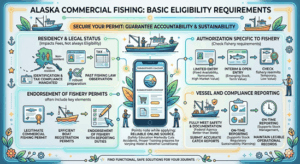
Basic Eligibility Requirements – Alaska Commercial Fishing Permit
To secure a commercial fishing permit in Alaska, you must pass various requirements. These requirements guarantee accountability and sustainability for all fisheries.
Status of Residency & Legality
Although residency may impact fee structures, it does not always determine eligibility. Both residents and non-residents can apply for many permit types. Applicants must also meet identification and tax compliance requirements.
Legal standing also refers to the observation of past fishing Permits. Permit eligibility or renewal may be affected by.
Authorization Specific to Fishery
Each fishery has its own rules. There are limited entry permits for some fisheries, others may be interim and open entry. Before applying, applicants must check the fishery requirements.
Often include key elements
- Legitimate commercial fishing permit.
- Efficient boat registration.
- Endorsement of fishery permits
- Complying with reporting duties.
Not meeting any element may delay approval or restrict participation.
Vessel and Compliance Reporting
All commercial Fishing are to fully meet safety and documentation. Compiling documentation for federal agency is better than state registration.
Operators must also submit accurate catch reports. Reporting on time supports stock management. Regulatory authorities depend heavily on landing data for sustainability planning.
Maintaining legible operational records can significantly mitigate compliance risk and enhance the permit status protection.
Limited Access versus Open Access Fisheries: A Practical Comparison

- Because the supply remains fixed, the Limited Entry Permit holds significant value as a financial asset. Open Entry systems are not of much market value as they are mostly unlimited and non-transferable.
- The entry costs to a limited fishery are significant and require substantial capital or financing (8/10). Systems that feature open entry impose a Minimal (2/10) barrier accordingly facilitating access to newcomers – and hence, more crowded.
- With few entries in the market, the income stream created due to it becomes much more predictable for you and your business. (8/10) The income from open entry is highly variable (4/10) as it fluctuates with the number of active vessels and effort seasonally.
Securing a Alaska Commercial Fishing Permit
Planning helps to eliminate confusion and costly delays. The first action you should take is identifying which fishery to enter. Investigate if it has limited entry or open entry rules.
Adopt this systematic method
- Check fishery classification availability.
- Get a license for commercial fishing.
- Register and record your boat.
- Send the application materials with fees.
Repurchasing of a limited entry permit, having done due diligence. Examine the permit’s past income potential. Know regulations and legal conditions on transfer.
Finance preparation plays a key role. Certain permits necessitate large investment. Financing plans must match income timing.
Upon approval, keep track of renewal dates. Many permits and licenses require annual renewal. Conclusion about Missing deadlines may incur penalty or suspension.
Regulatory changes keep you compliant, be aware of them. Fisheries´´ management is data-driven and evolves constantly.
Developing a Commercially Sustainable Company – Alaska Commercial Fishing Permit
An Alaska commercial fishing permit allows access to the world’s most valuable fishery. However, it requires preparation, compliance, and strategy. The system manages between conservation and economic opportunity.
Entry permits with limited entry level provide stability and an asset value. Accessible competition in open entry fisheries relates to entry conditions and regulations. The licensing requirements, vessel registration, and reporting rules apply to both and services from Commercial Fishing Permits Center can help ensure proper documentation and compliance with federal maritime regulations.
Gaining insight into something reduces the risk of that thing. Proper planning allows fishermen to focus on productive work instead of paperwork setbacks.
When the commercial fishermen approach the process with discipline, they can act confidently in Alaska’s system. The permit is beyond just a document. It is a symbol of responsibility, opportunity and long-term involvement in a highly regulated sector.
No Comments
Be the first to start a conversation