Alaska’s halibut sablefish and CDQ halibut program has emerged as an integral fisheries management program in Alaska. The Alaska IFQ Halibut Sablefish and CDQ Halibut Program was created to promote sustainable harvest of halibut and sablefish as well as the continued economic viability of the participation coastal communities of Alaska. It regulates the harvesting of halibut and sablefish that includes fair access and sustainability. It is important for vessel owners, permit holders and fishing communities to know this program.
Prior to the implementation of the program, there were risks to safety and economic uncertainty due to short fishing seasons and competitive harvesting. The program enacted individual fishing quotas and community allocations, which changed the way fisheries work. As the amendments promoted safety at sea they enabled better planning.
This guide covers the features of the Alaska IFQ Halibut and Sablefish Programs and CDQ Halibut Program. The program’s functioning, eligibility criteria and comparison with other fishery systems are covered in this study. In order to comply confidently, guidance is practical. You will know how this program helps with sustainable fisheries and stable coastal communities by the end.
Understanding the Alaska IFQ Halibut Sablefish and CDQ Halibut Program
The Alaska IFQ Halibut Sablefish and CDQ Halibut Program integrates two essential management systems. Harvest privileges are allocated to individual qualified participants Community Development Quotas set aside a share of the harvest for qualified western Alaska communities.
Individuals or entities receive annual catch limits under the IFQ component. These limitations are based on past participation. Fishermen can use this method for evaluating season planning safely.
The development of remote communities is fostered by CDQ. It helps local communities whose livelihoods depend on the ocean get access to fish. This balance ensures fairness and sustainability.
| Program Element | Key Feature |
|---|---|
| IFQ system | Individual catch allocations |
| CDQ system | Community-based access |
| Safety improvements | Extended fishing seasons |
| Conservation focus | Strict annual catch limits |
Eligibility, IFQ Shares, and CDQ Participation
Alaska IFQ halibut sablefish and CDQ halibut program participation is carefully regulated. The rules concerning eligibility safeguard fish stocks and ensure fair access.
Individual Fishing Quota Eligibility
An IFQ’s eligibility is based on historical participation during qualifying years. Individuals received quota shares which generate annual catch limits. Different species and regulatory zone have different limits.
Quota shares can be transferred under certain circumstances. Transfer policies safeguard program consistency. It is important to know these rules.
Community Development Quota Participation
Only qualified communities can join CDQ program. These approved organizations manage allocations. CDQ groups can harvest fish or lease quotas to operators.
This structure aids job creation and infra development. Local communities are guaranteed direct benefits from fishery resources.
Reporting and Compliance Responsibilities
Reporting must be accurate under SCDQ and IFQ systems. Participating entities are to accurately track landings and submit reports as needed. A timely report will assist with enforcement and stock assessment.
Failure to comply may result in punishment or loss of quota. A strong recordkeeping helps to protect your fishing privileges.
Common Compliance Challenges
- Misunderstanding quota transfer rules
- Late or inaccurate landing reports
- Confusion between IFQ and CDQ requirements
- Poor communication between quota holders and operators
Avoid these problems by preparing and coordinating. Transparent operations uphold ongoing collaboration.
Alaska IFQ Halibut Sablefish and CDQ Program Compared to Other Fisheries
The Alaska IFQ halibut sablefish and CDQ halibut program is more closed access than open access fisheries. Its organized allocation system is different from competitive harvesting models.
| Fishery Model | Management Style | Operational Stability |
|---|---|---|
| IFQ and CDQ Program | Quota-based allocation | High |
| Derby Fishery | Competitive race | Low |
| Open Access Fishery | Limited entry | Variable |
Stability and Safety Comparison
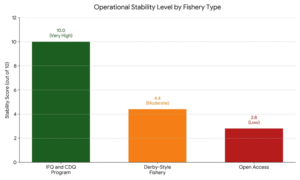
- Peak Institutional Stability: IFQ and CDQ program with a score of 10.0 is predictable and secure for fishers, local communities and resource managers.
- The Derby-Style Fishery scores much lower (4.4) since it is slightly unstable and there is a moderate risk due to being high-pressure and short-duration.
- Open Access systems demonstrate the lowest stable valuation of all the policies (2.8). That often leads to over-exploitation of resources along with economic trouble for the states or the participants.
Practical Guidance for Program Participants
Participants must be fully aware of their quota holdings. By reviewing the annual allocations, we can plan our trips. Awareness cuts down the chances of overharvest.
It is crucial to keep accurate catch records. Reliability Makes Compliance Easier. It is important for quota holders, vessel operators, and CDQ groups to effectively communicate. Coordination prevents misunderstandings and violations. It supports compliance by keeping yourself informed about regulations.
Best Practices to Follow
- Review IFQ and CDQ allocations annually
- Track landings carefully and consistently
- Communicate clearly with partners and operators
- Monitor regulatory changes each season
Following these practices supports safe and lawful fishing. Prepared participants avoid costly mistakes.
Supporting Sustainable Fisheries and Communities
One approach to achieve these gains may involve the modification of the Recent CDQ Halibut Plan. It enhances sustainability, safety, and economic opportunity. By knowing the program, they act responsibly.
The document explained the structure, the eligibility, and compliance rules. Comparisons showed the benefits of quota-based management. Practical instruction aided active engagement.
When fishers and communities participate responsibly in the Alaska IFQ Halibut Sablefish and CDQ Halibut Program, they help ensure the long-term health of this resource. Because they are prepared to cooperate, observers and the Commercial Fishing Permits Center can ensure the future stability of Alaska’s halibut and sablefish fisheries.
No Comments
Be the first to start a conversation