The Alaska Scallop License Limitation Program controls entry to the Alaska scallop fishery to limit fishing power in the area. The Alaska Scallop License Limitation Program is designed to minimize participation to qualified vessels and operators to protect the scallop stocks and promote safe, orderly harvesting activities. It is important for permit holders and vessel owners under this program to comply with applicable laws and long-term planning.
Alaska’s scallop fishing occurs in delicate oceanic ecosystems. If done to excess, this can harm stock sustainability & habitat health. The program to limit licensing was developed with a view to addressing these risks by managing entry and sustaining stable levels of participation. The approach ensures both conservation and economic viability.
This guide provides detailed information on Alaska Scallop License Limitation Program. It includes the fundamentals of the program, criteria for eligible applicants, what to consider when submitting an application and how the program compares to other fisheries. Includes guidance to help participants stay compliant and informed. Readers will learn how this program supports sustainable scallop fisheries and responsible operations at the end.
Understanding the Alaska Scallop License Limitation Program
A permit limiting the number of licenses to fish for scallops in Alaska was established. The fishery is open to vessels that hold a valid scallop license. By limiting access, unsustainable overfishing and excess capacity will be prevented.
Alaska fisheries often utilize license limitation programs. They simultaneously are conserving and providing opportunity. Regulators can better control fishing pressure by limiting entry.
Although the scallop fishery is not that big, it is very important. If Not Controlled, It Can Damage Scallop Beds. The program ensures that harvesting stays within sustainability limits.
Eligibility and License Application Considerations
Only eligible applicants can participate in the Alaska Scallop License Limitation Program. Rules are made to provide fairness and sustainability.
Vessel and Operator Eligibility
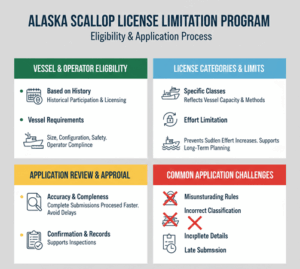
Typically, organizations with a license for active tendencies can participate. To be called a Vessel, the ship/boat must satisfy certain criteria pertaining to the size, configuration and operation. Such standards ensure uniformity and safety.
All fishery regulations relevant must be complied with by operators. Your application may get denied because of ineligibility criteria. It is essential to understand requirements beforehand.
License Categories and Limitations
Licenses for scallops may be available by vessel class. These classes show differences in the capacity of vessels and fishing techniques. Proper categorization guarantees equal involvement.
Restrictions on licensing inhibit effort from sharply rising. This stability allows permit holders to plan for the long term. It lessens the pressure of competition.
Application Review and Approval
Ensure you check applications for correctness and eligibility. Agencies process complete and accurate submissions more quickly, and errors can delay approval.
After approval, applicants must keep their confirmation records. Documentation supports inspections and enforcement.
Common Application Challenges
- Misunderstanding eligibility requirements
- Incorrect vessel classification
- Incomplete application details
- Late submission of required forms
Overcoming these challenges improves approval outcomes. Getting ready and focusing on details important.
Alaska Scallop License Limitation Program Compared to Other Fisheries
The Alaska Scallop License Limitation Program is not an open-access fishery. It’s controlled entry in contrast to fisheries with broad access. These differences in highlights the program’s benefit.
| Fishery Type | Access Model | Stock Protection Level |
|---|---|---|
| Scallop License Program | Limited entry | High |
| Open Access Fishery | Unrestricted entry | Variable |
| Quota-Based Fishery | Allocated harvest | High |
Effort Control Comparison
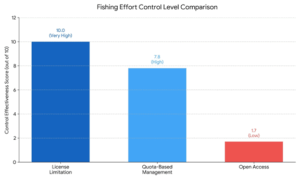
- The Primary Prevention Strategy known as License Limitation obtains an effectiveness score of $10.0$ by controlling access to the fishery and reducing pressure before any harvesting occurs.
- Quota-based Management has High control strength ($7.8$). It controls the Total Allowable Catch (TAC). This very useful secondary line of defiance for marine resources continues to be a strong protection measure.
- Open Access fisheries manifest a crucial deficiency in control ($1.7$), which is a Low effectiveness indicator. This often leads to overcapitalization and depleted stocks.
Practical Guidance for License Holders
License holders should review regulatory updates. Changes in rules may arise from stock assessments. Keeping up to date avoids compliance issues. It’s important to have updated vessel and license records. During operations, documentation should be available. Managing records simplifies inspections.
Organizing fishing activity within the limits sustains. Coordinating with regulators and industry groups can provide clarity. Effective communication gets rid of misunderstanding.
Best Practices to Follow
- Confirm license validity before each season
- Maintain accurate vessel documentation
- Monitor regulatory updates closely
- Plan fishing effort responsibly
Following these practices supports smooth operations. Prepared license holders avoid unnecessary disruptions.
Supporting Sustainable Scallop Fisheries
A very important fisheries management program for one of Alaska’s directed fisheries is the Alaska Scallop License Limitation Program with Commercial Fishing Permits Center. It, by restricting entry, prevents any damage to the scallop stocks and encourages stable participation. The program would help the operators to fish better.
The guide explained program structure, eligibility, and comparisons to other fisheries. Insight eases doubt and danger. License holders ensure sustainability of the Alaska scallop fishery by responsibly participating in the program. Protecting fishing opportunities and marine environment through compliance. Alaska’s scallop fishery has a bright future with balanced approach.
No Comments
Be the first to start a conversation