The flatfish exchange application is a key administrative tool used in Alaska’s regulated fishery. The thing allows eligible participants to trade flatfish quota or allocations according to the rules of the program. This allows for operational flexibility while meeting conservation objectives. The exchange process helps fishers balance their harvesting possibilities with regulatory constraints in complicated quota.
It is important to manage quotas for flatfish species and other groundfish. Without exchange mechanisms, vessels may suffer from inefficiencies, early closures or unnecessary bycatch risks. The application procedure exists to limit these challenges while ensuring transparency and accountability.
The Flatfish Exchange Application has been explained clearly and professionally in this article. This explains what the app is, why it exists, and how it fits into Alaska’s larger fisheries management structure. If operators and stakeholders understand the functioning, they can confidently navigate quota exchanges and remain compliant throughout the season.
Summary of the Flatfish Exchange App
Flatfish Exchange Application is for the submission of application for the exchange of flatfish allocations in accordance with the law. The purpose of these transactions is to enhance operating efficiency while maintaining total harvesting levels within limits.
The application process assures documentation and review and approval of exchange before it happens. This ensures the safety of the fishery and participating entities. Valid and supported documentation saves unauthorized transfer and quota accuracy.
The Flatfish exchange application is very flexible for trading.
Fisheries face changing conditions, with catches with mixed species and stock shifting. Mechanisms of exchange enable operators to adapt without violating quotas.
It allows monitoring from the administration’s point of view. Regulators can oversee exchanges, evaluate cumulative impacts, and verify conservation goals remain.
| Aspect | With Exchange Application | Without Exchange Application |
|---|---|---|
| Operational Flexibility | High – Allows vessels to adjust their harvest capacity based on real-time market or weather conditions. | Limited – Operators are restricted to their initial allocation, regardless of mechanical issues or seasonal shifts. |
| Quota Utilization | Efficient – Unused quota can be transferred to active vessels, ensuring the total allowable catch is fully utilized. | Restricted – Portions of the quota may go unharvested if individual permit holders cannot reach their limits. |
| Compliance Confidence | Strong – Reduces the incentive to “bycatch” or discard, as extra quota can be legally acquired. | Moderate – Higher pressure on operators to stay exactly within strict, non-negotiable limits. |
| Risk of Early Closure | Reduced – Distributed fishing effort prevents “pulses” that could trigger emergency fishery shutdowns. | Higher – If a subset of the fleet harvests too quickly, the entire fishery may be closed prematurely. |
Flatfish Exchange Process: Know how it works
When applicants learn how the Flatfish Exchange Application works, they can submit better applications and minimize delays.
Eligible and Qualifying Exchanges
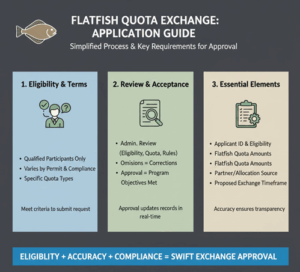
Not all participants nor all quota types are eligible to exchange. Eligibility varies depending on terms, allocation status and compliance record. Request submissions can be made only if one meets certain criteria.
I don’t know what to say to this very common defense! The application must identify the amounts and the parties. Exactness is vital for endorsement.
Review and acceptance issues
The applications will first be reviewed administratively once submitted. Authorities check eligibility, availability of quota & compliance to rules. Applications with omissions or inaccuracies may be returned for correction.
Approval means exchange fits to objectives of program. Upon confirmation, the quota records get updated accordingly in the system. It guarantees tracking and accountability in real-time.
The application generally needs a few common elements
- Verify the identity and eligibility of the applicant.
- The amounts of the flatfish quota.
- Other partner or allocation source.
- Proposed time for exchange.
All four elements support transparency and accuracy.
Comparing Fisheries Outcomes With and Without Trade
The Flatfish Exchange Application’s impact becomes more obvious when comparing fisheries outcomes. Fisheries with exchange access often operate more efficiently and sustainability.
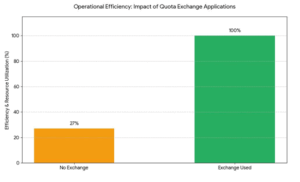
- Maximizing Sustainable Yield: Switching to an Exchange Used model delivers efficiency at 100% to ensure the scientifically-based Total Allowable Catch is achieved – and not left behind due to the limited capacity of individual boats.
- Operational Agility: The approved exchange can enable the fleet to shift harvest rights to active vessels owing to unexpected mechanical failure or sudden weather changes. In contrast, No Exchange (27%) induces a more rigid use it or lose it situation.
- Eliminating “Ghost Quota”: Removing Ghost Quota: By enabling underutilized exchange applications, the fishery cannot be allowed to sit’ without harvesting’ – whereby significant portions of the fishery go unharvested because some permit holders do not have the immediate capacity to fish.
- Economic Resilience: The fishery’s legal right to transfer empowers smaller operators with a financial safety net. If a small operator has a down season, they can lease out their quota which helps them maintain cash flow whilst not losing their permanent position in the fishery.
The graph shows that we are more efficient using exchanges. Although simplified, it still shows operational trends.
For example
A vessel fishing for mixed flatfish species nears its quota limit for one of them. The operator adjusts his allocations via an approved exchange and continues fishing. If there is no access to exchange, the vessel would close prematurely
Support of both compliance and economic stability – demonstrates this example.
Directions for submission of an application
It is Important to Prepare a Flatfish Exchange Application. Applicants must confirm their eligibility by reviewing the rules of the program prior to submission. Familiarity with requirements reduces processing delays.
Quota calculations should be Accurate. You may be rejected or asked for clarification if you make errors.
Verifying numbers enhances chance of approval
The Moment Counts. Get Applications In Early So There Is Sufficient Time To Review It Last-minute submissions may be delayed during peak times.
Keep accurate records of approvals and confirmations. Support external verification and future uses. Maintain transparency for the good of everyone.
Confirm qualification prior to applying
- Make sure you have proper documents.
- Try to submit applications as early as you can.
- Store your acknowledgement confirmations safely.
These steps help in the transaction.
Importance of the Flatfish Exchange App
The Flatfish Exchange Application helps the modern fisheries sector make more efficient use of regulated systems with structural flexibility. Operators can adapt to real-world conditions through the application of conservation limits and program rules
The application enhances efficient quota utilization and minimizes unnecessary operational disruptions for fisheries. Commercial Fishing Permits Center It helps managers observe quotas for transparency and accountability.
When possible, under normal circumstances, citizens of covered countries or nationalities must be allowed entry.
The Flatfish Exchange App is an important tool that balances sustainability, compliance, and economic viability in Alaska’s fisheries.
No Comments
Be the first to start a conversation